I often wonder about the history of my salvaged pieces and whether anything significant has happened around them in their lifetime - who sat on those chairs before I adopted them, what child rocked on that rocking horse I'm renovating, for whom was the play shop I picked up at a flea market made? It is all so intriguing, but I will never know their stories.
For one of my recent aquisitions, however, things are a little different. I can speculate with a bit more certainty. The cellar window I picked up from a house in our village that was being gutted and renovated must have many tales to tell. The house, although one wouldn't know it to look at it now, must be somewhere between 70 and 100 years old. The window looks as if it was an original, with its woodworm-ridden frame, cracked filler and thin glass.

I loved the look of the window when I spotted it left out for the binmen a while back. But the brown paint that had been applied in a very slapdash fashion to the frame and metal handle was very ugly. At home, I took a wire brush to it and brushed the flaking paint off the frame and freed up the metal fittings and glass panes as best I could with paint remover. Finally I washed the panes with soapy water to remove the grime and last remnants of paint.
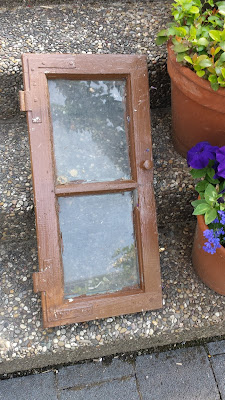
 Cleaning the window, it suddenly dawned on me that I was looking through the window, a window. A window that in its original position had been a cellar window facing onto the main street of our village, just a few inches above the footpath. On either side of the glass I held in my hand, life had gone on for decades and decades. I got goosebumps as I thought of all that had occurred during the lifetime of this simple window.
As you may know, I live in Germany, not far from the border to Alsace and on the banks of the Rhein. The second world war had a huge impact in this area.
Perhaps through this window the the feet of the local Catholic priest may have been seen passing by in the period before his internment in the concentration camp in Dachau. Or possibly afterwards, when he returned to the village in 1945 and, incredibly, resumed his job. Was this cellar left empty during the evacuations of villagers in 1939 and 1944? Did the panes rattle in their frames when the nearby bridge over the Rhein was blown up in March 1945? What was observed through it during the occupation of the village through French forces in the post-war period?

I loved the look of the window when I spotted it left out for the binmen a while back. But the brown paint that had been applied in a very slapdash fashion to the frame and metal handle was very ugly. At home, I took a wire brush to it and brushed the flaking paint off the frame and freed up the metal fittings and glass panes as best I could with paint remover. Finally I washed the panes with soapy water to remove the grime and last remnants of paint.


As you may know, I live in Germany, not far from the border to Alsace and on the banks of the Rhein. The second world war had a huge impact in this area.
Perhaps through this window the the feet of the local Catholic priest may have been seen passing by in the period before his internment in the concentration camp in Dachau. Or possibly afterwards, when he returned to the village in 1945 and, incredibly, resumed his job. Was this cellar left empty during the evacuations of villagers in 1939 and 1944? Did the panes rattle in their frames when the nearby bridge over the Rhein was blown up in March 1945? What was observed through it during the occupation of the village through French forces in the post-war period?
Anyone looking through this window in the late 1940s would have witnessed the rebuilding of the village, the industrial development and the influx of refugees from the eastern parts of Germany.
Does this cellar window feature in the film that was shot in the village in 1957? Or did it, ten years later, witness the celebrations of the twinning with a town in Normandy brought about by a French soldier who was stationed in the village after the war? Did it see people take to the streets in celebration after the Wonder of Bern, Germany's surprise World Cup win in 1954? Or the fall of the Berlin Wall in 1989?
Does this cellar window feature in the film that was shot in the village in 1957? Or did it, ten years later, witness the celebrations of the twinning with a town in Normandy brought about by a French soldier who was stationed in the village after the war? Did it see people take to the streets in celebration after the Wonder of Bern, Germany's surprise World Cup win in 1954? Or the fall of the Berlin Wall in 1989?
Now, so many years after this window was first installed, I couldn't let it go to the dump just because the house it was part of was being renovated. I felt it had to stay in the village, just with a new home. It is no longer a window to the activity on the main street. It is spending its retirement looking out on our garden, watching as a new generation of village children grown, a silent observer as we make our own history.


