Showing posts with label learning. Show all posts

Monday, 31 August 2015

Now We Know Our ABCs

We are only now coming to the end of the six-week Summer holidays. School will resume for Number One next week. Lately I have been reflecting on Number One's development. He has made such progress in the past few months. I can hardly believe the change in him. Last September he could write his name and that was it. Now, 12 months later he's reading whole books in German and in English and can write in both print and cursive. 

It was a tough year for him and it has made me determined to have Number Two better equipped for dealing with school. Number One had been keen on learning but we didn't want him to be bored at school, so we followed all the advice from teachers and kindergarten not to teach him to read or have him learn the alphabet. He'd learn all that at school, they said, and in the end he did. But it was a very steep learning curve, not made any easier by the fact that many children in the class could read and write on starting school.  I feel that he'd begun to lose interest in learning before school had even started.

Number Two has been following his big brother's progress and is very eager to learn, always spotting letters from his name and from other words he recognises. So we've decided to go against the advice and go with what our child wants to learn. I've rooted out all the ABC books I bought when Number One was younger. But best of all, I've bought us a brilliant new alphabet poster and matching mini poster that are perfectly suited to bilingual children like mine.

Love Your Lingo is an Australian company founded by an Irish woman called Una. I am ever grateful to Helen, The Busy Mama herself, for mentioning Una in a post and helping me discover these brilliant ABC posters. They cost around €20 each (the pricing is in Australian dollars and worked out at just over €19 the day I bought mine online). 

The alphabet posters and mini posters are of excellent quality and are highly unlikely to get ripped to shreds, the fate of most posters that some into this house. The illustrations are clear and the words chosen to represent each letter of the alphabet are ones that children will quite easily recognise. But for us the fantastic thing is that the words chosen begin with the same letter in German and in English. So B is for bath / Badewanne, L is for lion/Loewe and T is for tower/Turm. I am over the moon to have discovered these. It has made such a difference to Number Two's confidence with letters already.
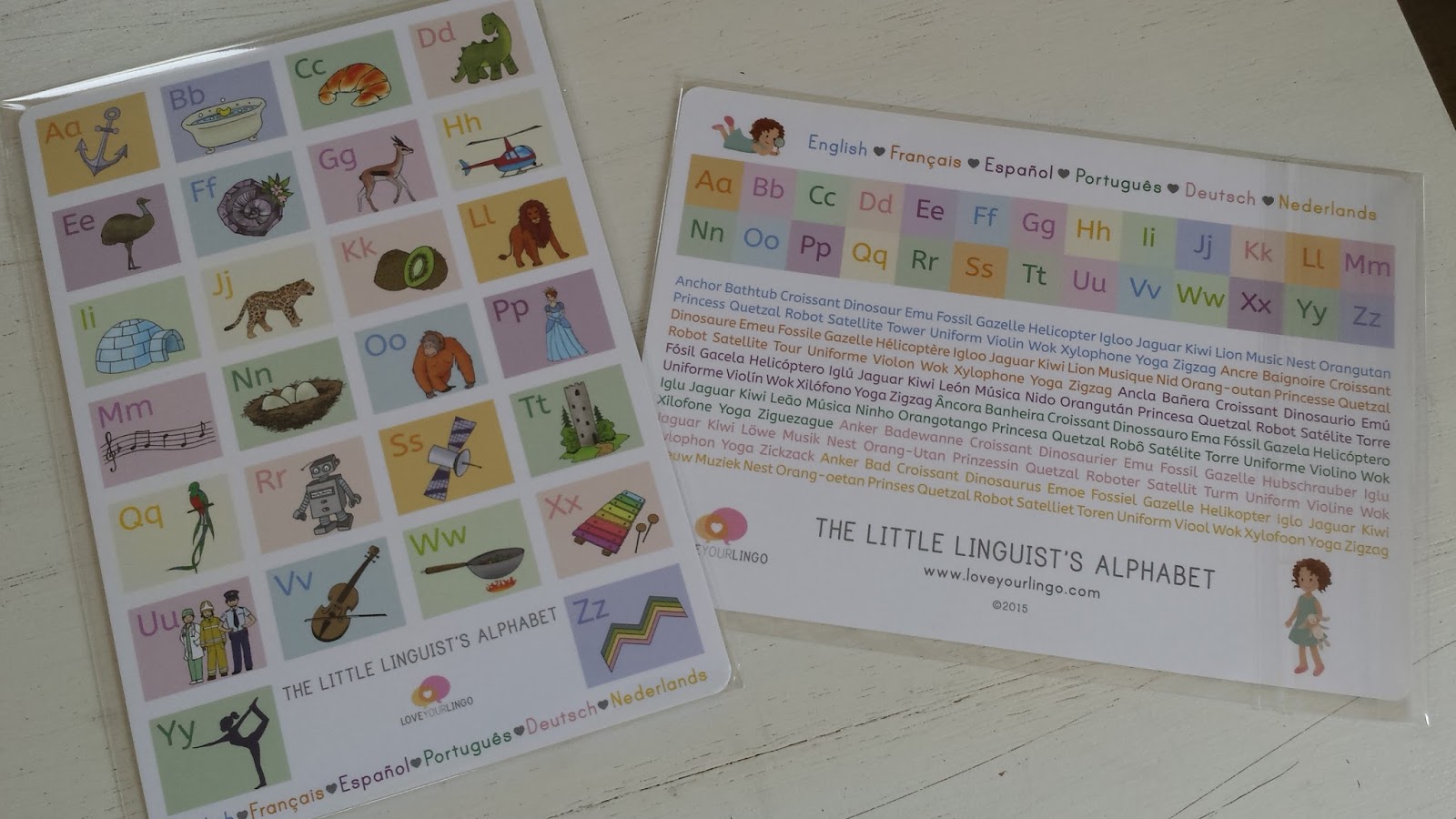
The Little Linguist's Alphabet from Love Your Lingo covers English, German, French, Spanish, Portugese and Dutch.
As I was re-visiting our alphabet books, I found this one which I had forgotten was multi-lingual. Wenn Raketen Träumen (When Rockets Dream) is a brilliantly imaginative ABC book for space-loving boys like mine. We came across it by chance a couple of years ago in our local newsagents and only discovered when we got home that it was multilingual.
Each page depicts the rocket dressed up as something different, with D for Dragon/Drache, F for Fish/Fisch, P for Penguin/Pinguin, etc. Some are a bit tricky to name, like C for clown's nose/Clownsnase. 
The relevant word is written in the top left-hand corner of the page in seven languages, making it a great book for lots of families.
The boys had great fun spotting the rocket in each of the drawings and naming the creature or object he had transformed into. 


Apple Pie ABC by Alison Murray is a beautiful book to look at but not terribly helpful for small children. Number Two loves the facial expressions and cheekiness of the dog, but he is not overly interested in the story because the language used in much of the story is too advanced for his age group. A for Apple, B for Bake and C for Cool are fine, but Q for Quietly determinded is a bit out of his vocabulary. 


I'm excited to see how longs Number Two's interest in reading and writing keeps up. What was your experience with your children? At what age did they develop an interest in letters and reading?  
The Twinkle Diaries

Wednesday, 22 July 2015

My Kitchen a. k. a. Atelier, Centre of Education, Surgery, Refuge

I can spend whole days in my kitchen and not even notice I have been confined to one room for hours on end. It is by no means of vast proportions, measuring roughly 3.5m x 4.5m, but to me it is the perfect room. It is where I am now, actually. 

By perfect I don't mean the decor, as such, or the layout, moreso the feel and functions. It multi-tasks, in somuch as a room can. It is quite obviously a kitchen, having all the usual fittings - cupboards, sink,  kettle, dishwasher, hob, oven, fridge, microwave - as well as an extendable table and six chairs. At the same time it is so much more than a kitchen. 

For a start it serves as commnication central in our house. Of the two windows, one looks out the side of the house allowing me a view over the comings and goings of the neighbours, should I chose to look, and it overlooks the garden gate too. The second window looks out on the garden. Anyone approaching the front door has to walk past it. Needless to say our doorbell doesn't get much use since we have usually seen our visitors coming and have opened the door already. I generally do my blogging and anything else computer-related from the kitchen too because the light is better here than at my small and incredibly untidy desk in the no man's land between the livingroom and playroom.
Cheesemaking with my four year old
Cooking with figs from the garden

My cookery book collection is housed in one corner on a five-shelf-high bookshelf. On the short stretch of wall between the shelf and the window to the garden we have our set up our learing area. It features a map of Europe, a multilingual alphabet poster and our garden birds identification cards. As the boys have got to pre-school and school age so many questions have come up about nature, spelling, geography or food that this corner with the means for them (and us as parents) to answer their questions grew organically over the past couple of years, beginning with the bird cards. Jars of pens, pencils and safety scissors adorn the window sill along with an atlas, craft books and pre-school activity books. 
Part of our learning corner
 Any regular readers may have noticed the grey flooring that appears in the background of many of my photos. No, we don't have this throughout the house. It is only in the kitchen. When we bought the house I was delighted that we had a decent-sized shed, a garage and a guest room. I imagined I would have plenty of space to complete all my upcycling projects. And I do. Space is not the issue. Trying to fit these projects into life with three small boys is the issue. The kitchen is the only place where they can get done, unless I employ a nanny (not an option). So the kitchen has developed a parallel life as an atelier.  
The cradle renovation was carried out entirely in the kitchen
I am not the only one who gets creative in the kitchen. My children have a great love of experimenting, especially if it involves water, paint, food colouring or homemade volcanos. Again, the kitchen sacrifices its original function and becomes a science lab for an afternoon now and again.   
Experiementing with dyeing eggs
 Not least among the many and varied roles of this most wonderful of rooms is it that it serves as my refuge. Here I have my coffee maker, my pantry and my well-stocked wine rack. I have my books and my radio. I can write, bake or watch the children play in the garden. I can sit with a cuppa, my feet resting on a Tripp-Trapp, and feed Number Three. I can browse my craft books and cookbooks and favourite blogs. I can rest, cook or dream. 


Food photos from my cookery blog, My Kitchen Notebook


Home Etc

Thursday, 18 June 2015

5 Steps Towards Bilingual Children

"I wonder which languages Number Three will have Mammy?". Number 2 said this to me yesterday. "Deutsch, Brazilish [still obsessed with Brazil since the World Cup last year], English, Turkeys [I'm assuming he meant Turkish rather than gobbling like a turkey]. Maybe he'll speak like a Roman soldier! What do you think Mammy?"
It seems Number Two, 4 years old and bilingual in English and German, believes we are born with certain languages in us. An interesting notion. How funny the world would be if we all had a language or two in our genes. Imagine the excitement of waiting to hear your child's first words only to realise that they are in a language you don't understand. 

At the moment Number Three is nine months old and babbles away cheerfully or not so cheerfully, depending on his mood. While we have no idea what he is saying, he sounds like he's chatting with us at the dinnertable and there is no doubt that he complains if his food isn't getting to him fast enough! Hopefully he'll progress from "mam mam mam", "ga" and "abuwaba" to real words in the next few months. But it may take longer since he, too, is being raised bilingually. 

After seven years of bilingual family life, I think we've got this nailed. Here are the five things you need to know to raise children bilingually successfully.

1. Strict separation of languages: I only speak English with the children and my husband, The Bavarian, speaks German with them. It is easier for each of us to stick to our mother tongue and the boys have picked up both languages so easily, like little sponges soaking up water. Our pediatrician told us that if the languages are separated, i. e. if the child consistently hears one language from one person and another language from another person, they can distinguish them better. Think about it for a minute - a baby has no idea what language is. He hears words. How is he supposed to know which words belong to which language? However, if he hears one set of words (a language) from one person all the time and another set from another person all the time, he can distinguish and react to those people with the set of words he knows from them.

2. Repetition of the language: This is especially important if you live in a situation where the child doesn't hear one of the languages outside of the home. 
Hearing (passive repetition): CDs of songs in the language you want the children to pick up. This will give them a feel for the language in a fun way. Have the CDs on in the background while the children are playing. They will absorb the songs without realising.
Games and tasks (active repetition): From snap to tidying up the toys to setting the table, lots of games and household tasks provide the perfect opportunity to introduce and practice new words.
When Number One was a baby, we used to play the following game with him to encourage his English language skills. His favourite cuddly toy was Eyeore.
"Eyeore, where are you?" we'd call in a sing-song tone, looking round for the cuddly toy before getting ready for bed in the evening.
"Are you under the sofa?" (exaggerated looking under the sofa)
"No. He's not under the sofa."
"Eyeore, where are you?"
"Are you in the cot?" and so on, finishing with "Here he is! He was in the toybox." or wherever he happened to be.

3. Correcting without discouraging: It is important to correct mistakes in grammar, pronunciation and sentence structure. But it has to be done in a way that does not discourage the child from speaking. Be gentle. If for instance your child says "I goed upstairs", you can repeat the meaning of sentence but correct it as you repeat it, for example "You went upstairs? And then what did you do?". The child will realise you are listening to him and that he is making sense. He will feel encouraged to keep talking and should also pick up on the correction. You may find yourself repeatedly correcting the same mistakes, but eventually the child will begin to use the right words.

4. Reading and writing: Allow your child to get comforable with reading and writing in one language then introduce reading and writing in the second language. There is a huge difference between proficiency in speaking and in reading. You won't do your child any favours by trying to get him to read and write in different languages at once. Letting the child reach a level they are comfortable with in reading one language makes it easier for them to start reading in the second language. 

5. Don't let your pride get in the way: Whether you are an expat trying to teach your child your own first language or you are introducing a foreign language to your child at pre-school age, you can be faced with competitive parents. Don't give in to the pressure to compare skills or push your child to do better. Children learn at different rates. Some have an ear for languages, others are better at maths or sport. Let your child learn at their own rate. Be consistent and encouraging. Remember, praise works better than pressure.